 Mahanu
Chapter 3 — A Hundred Years Before It Was Born
≈ 2,600 words · 10 to 12 minutes read
Friday night is board games at our house, and Ved was staying over.
Thatha wandered in right in the middle of Ved's turn and started holding court on Vaastu again. Somehow, since Tuesday, he had transformed into a supreme expert on the vaastu rules. He grandly announced that the ancient masters had one sacred city they measured everything else in the world from. Ujjain, he proclaimed. They anchored the absolute center of the world at Ujjain.
Ved stopped with a tiny plastic hotel pinched in his hand and said, "Where's Ujjain?"
We dragged out the heavy atlas from Dad's shelf. Then Ved sprang up, his thumb rested squarely on the dotted printed line that slices across the middle of India.
Ujjain sat on it. Not near it. Directly on it—as close as a thumb can possibly tell.
That dotted line was the exact boundary we had found on Deepa Ma'am's globe using a flashlight. Above it, the noon sun is always, predictably, south of you. Drop below it, and twice a year, the sun crosses directly over your head and glares at you from the north.
And crucially, it does not run along the very top of India, which is where you would logically assume it belonged if someone confidently said north India and south India and you comfortably chose never to check. It runs through India. It slices through eight states. It cuts through places I had always vaguely categorized as 'north'—straight through the heart of Gujarat and Madhya Pradesh, passing under Bhopal, grazing the top of Kolkata by a razor-thin margin.
So it was never, ever as simple as north India and south India. It was above the line and below the line, and we had happily constructed our own smaller, equally incorrect version of the same wrong map mere hours after being handed the right one.
"It's almost exactly on it," said Ved, his thumb still pressing down on the paper. "Almost."
Suma gently took the atlas out of his hands and stared at it for a long, quiet time.
"I was completely right about the panels," she finally said, her voice stripped of its usual certainty. "I was completely wrong about the sun. I was so sure of myself, I didn't even notice they were two entirely different questions."
Nobody said anything to comfort her. It is a deeply uncomfortable, horrible sentence to have to say out loud, and she said it in front of her annoying little brother and his friends, over a scattered board game, on a Friday night.
Saturday morning, we abandoned all pretense. Hello, Narayanajja; how is the tea; and we marched straight through the side door.
Ved went hunting for the elusive prism. Anya and I lost ourselves in the hand-drawn maps and the intricate brass instruments. Suma went straight back to the notebooks, because she was still stubbornly chasing the secret of the solar panels, though I noticed she kept one wary eye on the shadowy shelf where the light had been.
I thought I saw it twice. Once hovering at the end of a dusty row of encyclopedias, and once pulsing near the heavy drapes of the window. Both times, it was only a flicker caught out of the very corner of my eye—which is exactly where dust motes do their most convincing work.
Then Suma spoke our names. Very quietly. Which is absolutely not how my sister says anything.
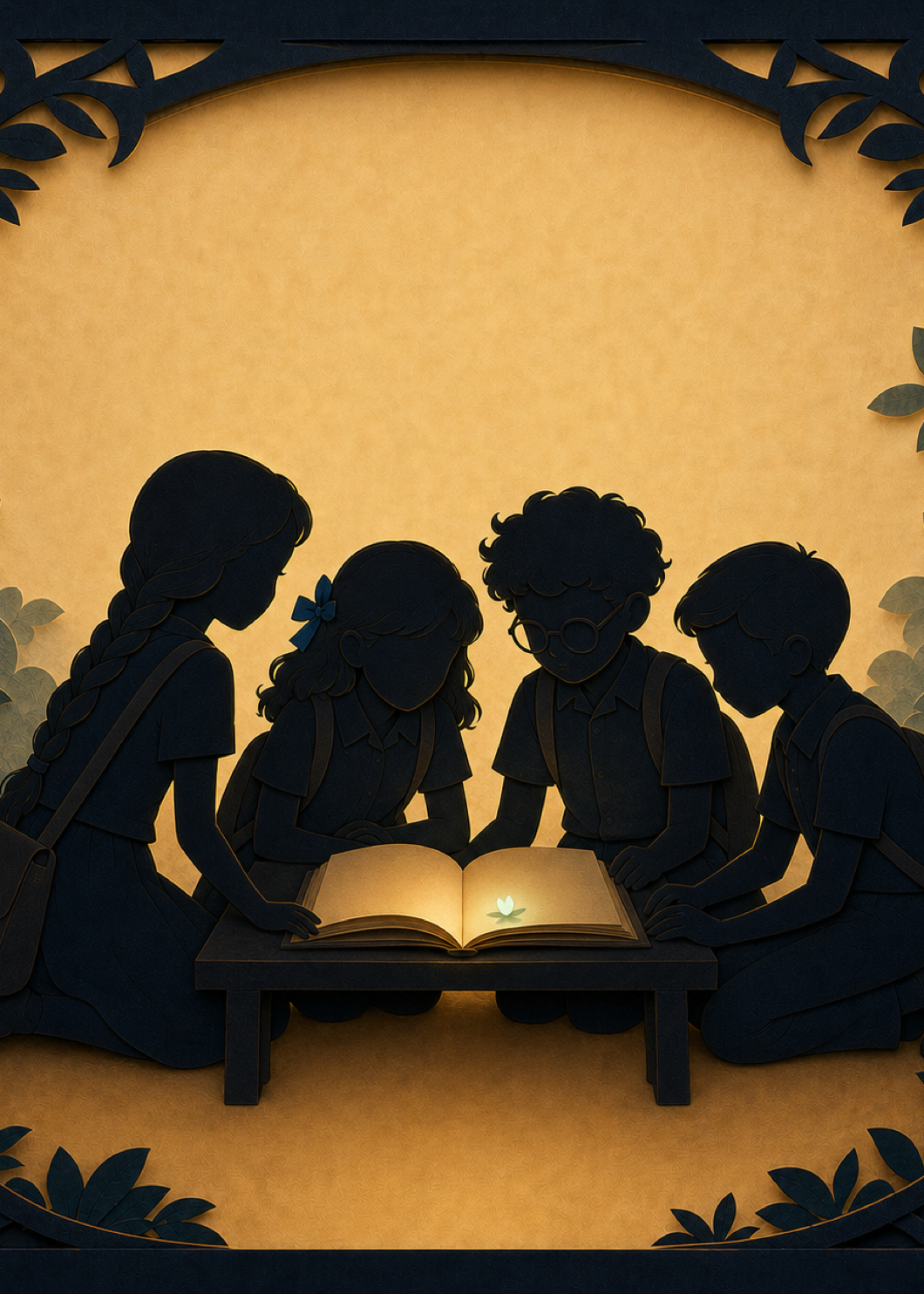
She was standing perfectly still. She had a thick book open flat on the table, and she hadn't screamed or climbed the furniture.
It was not a dense science notebook. It was a story—that was the unsettling part; I had never once imagined serious, Nobel-winning scientists sitting down to read stories, which is a foolish thing not to have imagined. It had pictures printed on the left pages and tight blocks of text on the right. The illustrations were old woodcuts, rendered in harsh, jagged knife-lines and deep black ink. The thick paper was mottled with brown blotches, like someone had carelessly rested a dripping coffee cup on it a century ago. Our art teacher forces us to try and fake that effect with wet tea bags to make fresh paper look ancient, and I have never once managed to make it look half this authentic.
There was a faint, greenish light sitting directly on the open page.
And there, perfectly mirrored in the ancient woodcut—carved deep into the wooden block, printed, and left to dry a hundred years ago—was the exact same shape. It was a small firefly, standing upright, sporting two tiny peaks on its head that looked like the letter M, and its feet were encased in shoes that were far, far too small for it to have traveled any real distance at all.
The living light and the dead one printed beneath it lined up exactly. Same two peaks. Same absurd little shoes. Not similar—the same, the way your reflection is the same as you, matched line for line, as though the bug had been sitting for its portrait a hundred years before it was born, or the woodcut had been waiting all this time for something to come and stand on it.
Nobody breathed. Anya's hand found my sleeve and closed on it. The back of my neck went cold and tight, the specific animal cold of being certain, without any proof at all, that something in the room had just quietly turned to look at us. Then the light on the page winked out—not flew, not faded, just stopped, the way a word stops when you finish saying it—and the woodcut firefly sat there alone on the brown-blotched paper, exactly where it had always been, exactly where the living one had just been, holding perfectly still and looking, I would have sworn, faintly pleased with itself.
We did not scream. We walked—too fast, too close together, nobody willing to be the one at the back—out the side door, down the drive, past Narayanajja and his broom, and straight home, and we did not say a single word until we were three houses clear of the gate.
And then we could not stop saying words.
Because here is the thing about running away: your feet leave, but the two questions come with you and will not get out of your head. First—how. A firefly that was alive this June, this Saturday, on this page, was cut into a block of wood a hundred years before any of us existed, down to the ridiculous shoes. Either that was the most staggering coincidence in the history of coincidences, or that book had somehow gotten there first. Neither answer let me sleep.
And second, quieter but somehow worse: it wasn't a science book. Sir B. W. Sawan had a whole wall of notebooks, a lifetime of measuring the actual world down to the millimeter—and the one book left lying open on his table, the one the impossible firefly had chosen to sit on, was a story. A made-up thing, with woodcuts and villains and, presumably, an ending. The most careful measurer of real things in the country had spent his last quiet hours reading something that never happened. I could not make those two facts share a shelf in my head.
For the rest of the week the thought of the shadowy study gave me a genuine cold jolt in the stomach, and twice I dreamed the little printed bug turned its head.
And we were, every one of us, going back. Not just for the prism anymore. For the book.
Sunday is my twelve hours of uninterrupted sleep. Sunday is sacred.
Anya pounded on the door at ten in the morning. Mum, a traitor, let her in. I was still blissfully horizontal when Anya stormed into my room and yanked the blanket off.
"We didn't finish it," she said, breathing hard as though she had run all the way.
"Finish what?" I mumbled into the pillow, "We ran away from a ghost bug. That felt pretty finished to me". But the book had been chewing at me all night. It was Sunday. "Whatever it is, it can wait till I've slept."
"Narayanajja's pots. He moved all of them."
"I know. You were there."
"But if he moves all of them," she said, pacing the narrow space between my bed and the desk, "how does he know it's the sun?"
I sat up slowly, my brain finally deciding to boot up. "What else would it be?"
"It's been brutally hot all month," she said, ticking it off on her fingers. "There hasn't been a drop of rain. The city's water is half empty. If the calatheas die now, is it because they're on the wrong side of the house, or because there's a drought?"
She was right. If you change everything at once, you never actually learn which thing caused the change.
She hauled me out of bed, loudly refused Mum’s offer of hot breakfast on my behalf, collected Suma off the living room sofa, and marched us all to Ved's gate.
When she demanded we go back to the bungalow, I adamantly refused. She swore we wouldn't step foot inside the terrifying study—we would only talk to Narayanajja. I grudgingly yielded.
Narayanajja was sweeping dried leaves off the driveway when we marched up.
Anya didn't even say good morning. "You need to move one lotus pot back," she told him. "Just a single one. And one calathea pot. Move them back to exactly where they were on Tuesday."
Narayanajja leaned on his broom and stared at her with the blank expression of a man who has just been asked to water a rock. "Why?" he asked.
Ved got it. And I saw the realization hit him. "As a control," he said, his eyes going wide.
Suma nodded, stepping up beside Anya. "If you move all the calatheas to the shade and they get better, maybe it's just a cooler week. But if you leave one baking in the front..."
"...and only the shaded ones perk up," I finished, "then you know for absolute sure it was the sun."
You have to leave one behind. One lotus that absolutely does not move, and one calathea that stays put in the sun. When the moved plants fare better or worse, you have something to compare them to, and the oppressive heat and the missing rain can stop unfairly taking the credit.
Suma immediately slipped into project-manager mode. "We have to write it down," she said. "Every single day. Both sides of the house, dating the entries properly, with absolutely no cheating or filling it in on Sunday from hazy memory."
We needed a field book. Ved triumphantly announced he had one: a neglected diary from two Christmases ago with exactly three days used.
And I said we needed the stick.
Because if the blazing sun really does walk across the sky, then it is walking right now, creeping a tiny bit further every single day. And you can trap it and measure it. You hammer a perfectly straight stick into flat ground, you carefully mark the absolute tip of its shadow at exact midday, and you repeat it every day, watching the chalk mark slowly crawl across the dirt. It isn't a clock. Nobody in Rajgudi needs another clock. It is a calendar—the shadow of the stick tells you exactly where in the vast year you are standing.
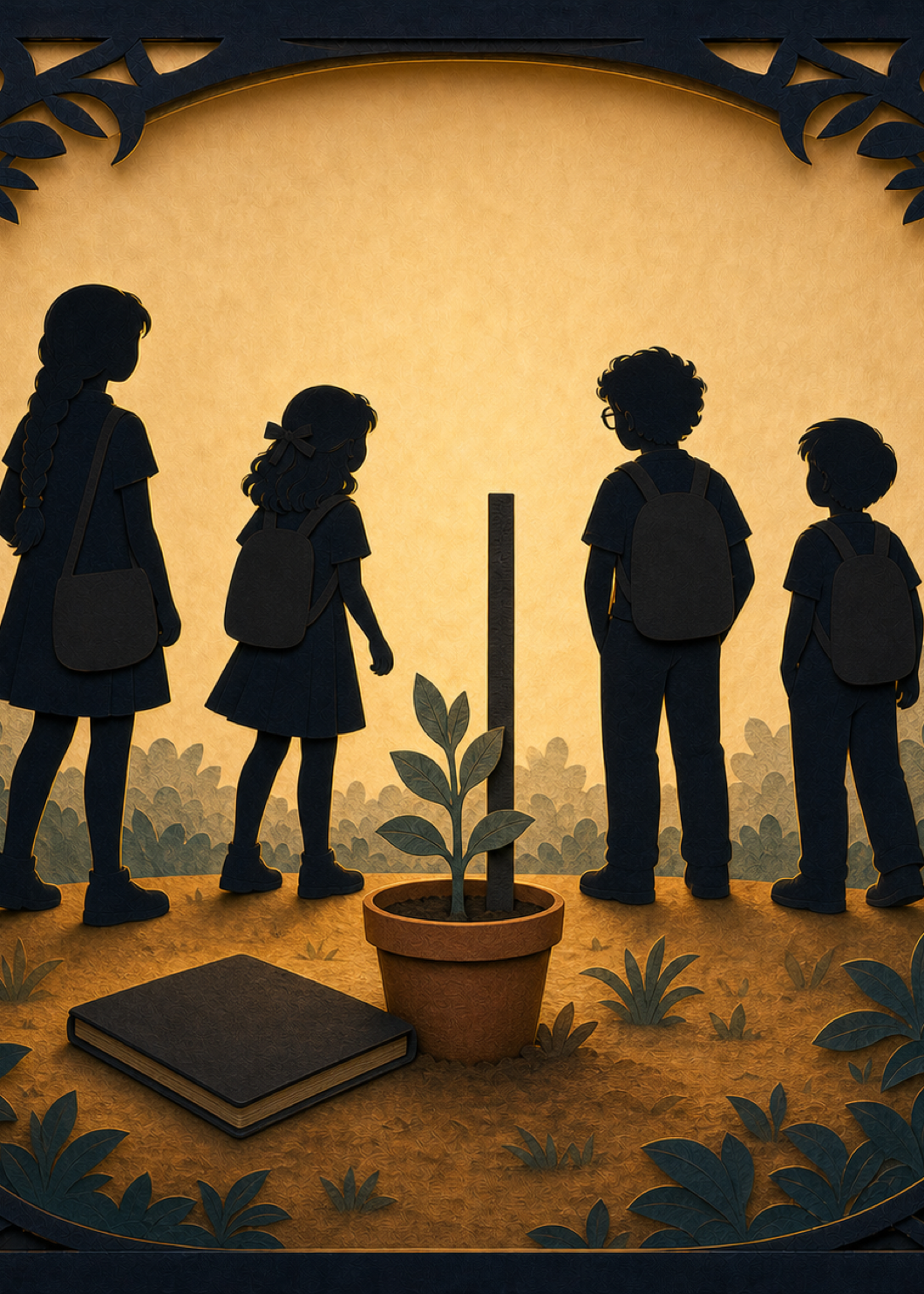
And here is the astonishing thing we painstakingly worked out while sitting on Narayanajja's dusty step, armed with four kids, a heavy atlas, and the blank back pages of Ved's diary. It took us most of the morning, involved two fierce arguments, and required Suma to verify the math twice.
The midday shadow is short right now, and it points stubbornly south, and it has been shrinking a little bit more every day since we dragged ourselves back to school.
So, it is inevitably going to hit zero.
There is going to be a day—one specific day, somewhere in the mid-August if the clouds oblige, we calculated—when the noon sun will sit exactly, precisely overhead, and the wooden stick will cast absolutely no shadow at all. Nothing. And the very next day, the shadow will miraculously reappear on the other side, pointing steadily north, and it will keep stretching and growing all the way until Christmas.
That zero-shadow day is the exact moment the scorching light on the front of the house crosses over to the back.
And Thatha, it turned out, had not been wrong about the walk. The sun really is walking south right now—it set off on the longest day, exactly as he said, and it will keep going till Christmas. But there was one thing he had folded up and put away without ever looking at it too closely: the sun walking south is not the same as the sun shining from the south. Not here. Right now it is strolling southward across the sky and still leaning over us from the north—the way you can be walking toward a door and still looking back into the room.
The two don't agree until one particular day—the day the shadow shrinks to nothing—and only from then on does the light actually come from the south, the way the textbooks had promised all along. Thatha had the walk exactly right. He simply never checked which way the light was falling while the sun took it.
That day—not the first arbitrary day of the month, not a religious festival, not exactly six months after the last swap, not any date any elder ever blindly handed down to us—is the true day the pots have to move again.
Narayanajja stood there and listened to this entire chaotic presentation without uttering a single word. He is not a man prone to dramatic outbursts in front of children.
Then, very softly, he said: "Sahebru had a walking stick."
And he turned and walked around the side of the grand house to search the sheds for it.
They were all excitedly shouting over each other by then—Anya demanding where we should plant the stick, Ved arguing about how to find true midday when your digital watch is inaccurate, Suma lecturing about which page of the diary was meant for which plant—everyone excitedly finishing everyone else's sentence, and nobody bothering to finish their own.
So, in the chaos, I was the only one left facing the house.
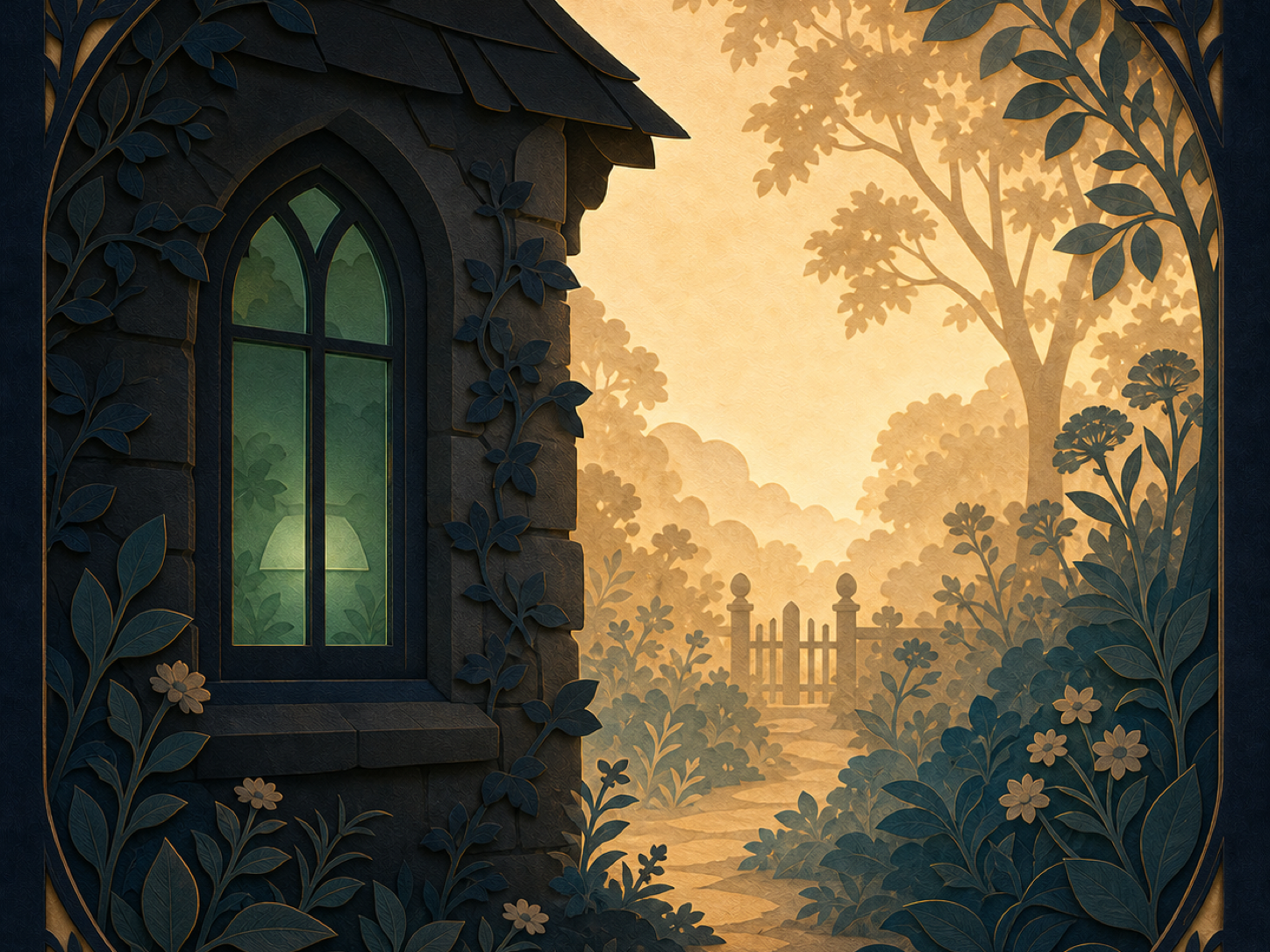
There was a light glowing in the heavy glass of the study window. It wasn't the dim orange of the old bulbs; we hadn't gone inside to flip the heavy switches. It was small, steady, and intensely greenish, sitting patiently on the inside of the pane, looking out over the garden. It looked far brighter than it had on Friday, which made no logical sense since it was a blindingly bright June morning.
I did not point it out. I did not say a word. I am still not entirely sure why.
Should we go in?
Not today. Today, we had a stick to hammer into the earth, and a pot that was staying put, and a pot that was moving, and an old diary with three days used and a vast, empty year left waiting in it.
I had spent my whole life counting Sundays as the day nothing important happens.
This was not a normal Sunday. Somehow I know that no Sunday will ever be normal again.